

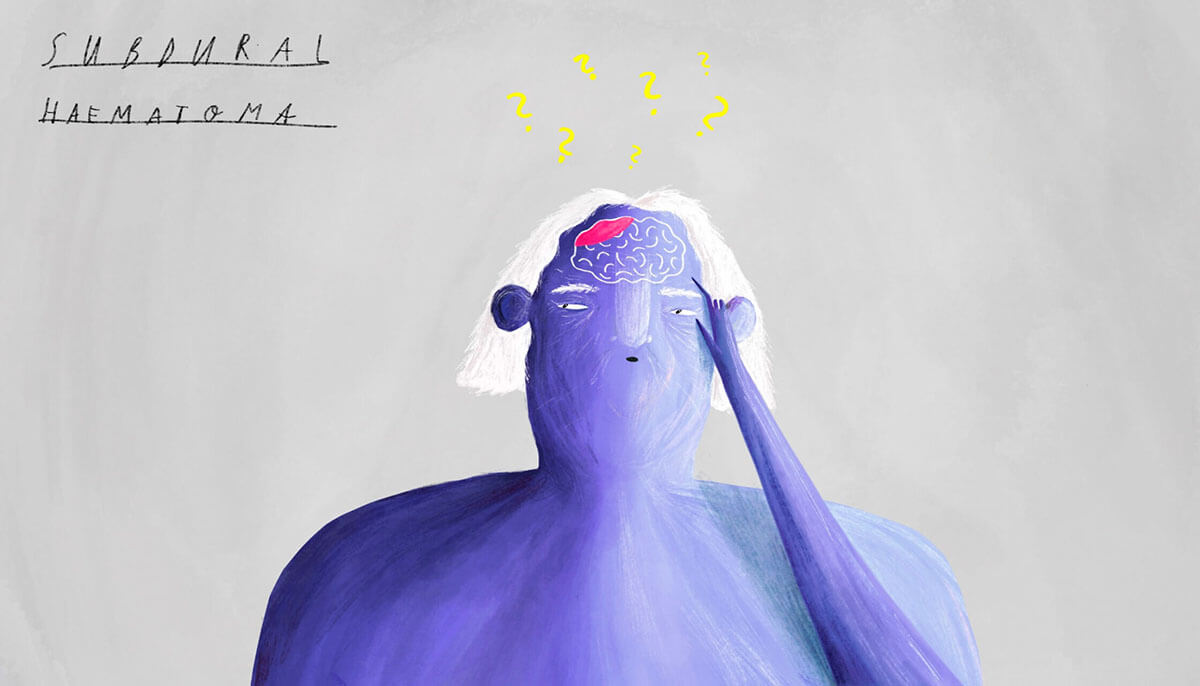
A subdural haematoma is a blood clot that forms on the surface of the brain, without penetrating the brain tissue itself.
The brain is protected by three layers of linings that wrap around its entire surface. Between each of these layers is a thin space, one of which is the subdural space—an area where blood commonly accumulates.
If left untreated, these haematomas tend to gradually increase in size, placing pressure on the brain. In older individuals, this pressure can lead to confusion, disorientation, memory problems, and even weakness on one side of the body.
Chronic subdural haematoma (often abbreviated by neurosurgeons as CSDH or simply “chronic subdural”) is common in elderly individuals on blood thinning medications. They often follow a minor head bump—sometimes so subtle it’s forgotten—leading to a slow build-up of blood over weeks or months. As the clot expands, it can cause a gradual decline in brain function, affecting memory, mood, or movement.
Acute subdural haematomas typically occur in younger individuals involved in high-speed accidents, often when alcohol or drugs are involved. Despite being a subdural haematoma, it is vastly different from the chronic form seen in older adults.
Chronic subdural haematomas, if untreated, can become life-threatening, following a slow and prolonged deterioration of brain function as the blood clot slowly gets bigger and bigger over weeks and months.
With acute subdural hematomas, on the other hand, patients are usually in critical condition, and often require a breathing machine and urgent, life-saving surgery.
The symptoms of chronic subdural haematoma are simply due to pressure on the brain. This results in gradual worsening of brain function.
Classic symptoms include:
Families often share that just weeks prior, their loved one was active—gardening, shopping, and living normally—only to now be confused and barely able to function, a stark contrast to their previous self.
Subdural haematomas are caused by trauma.
In severe trauma, such as a motor vehicle accident, rapid bleeding occurs into the subdural space and becomes life-threatening within minutes. This is called an acute subdural haematoma, with “acute” referring to the rapid onset. Acute subdural haematomas are more common in younger people involved in high-speed accidents.
In contrast, older people may develop a chronic subdural haematoma, which is a very different condition. This involves a slow collection of old blood in the subdural space. Unlike the acute form, where fresh blood rapidly accumulates, a chronic subdural haematoma builds up over one to two months before symptoms even begin to appear.
Chronic subdural haematomas typically requires surgery since most cases do not resolve on their own. It involves washing out the CSDH through two small burr holes. Unlike a typical blood clot, the fluid looks more like motor oil, a thick, black liquid. This blood is easily washed out through the two small holes, making it a very easy and straigthforward treatment
Acute subdural haematomas, in contrast, require emergency surgery almost every time, as blood clots put pressure on the brain which needs to be released as quickly as possible.
Surgery for chronic subdural hematomas is one of the simpler and less invasive brain operations, with risks mainly related to the patient’s overall health.
Because most of the patients are older, they often have other medical conditions that need to be addressed before they can safely undergo anaesthesia. In some cases, surgery may not be possible due to poor overall health.
The goal is for you to fully recover and this is often achieved, with only a a 30% chance the haematoma could recur.
If untreated, a chronic subdural haematoma can become life-threatening.
No, it is not genetic. A subdural haematoma is always caused by trauma.
Yes, after surgery there’s a 70% chance of being cured. However, there’s a 30% chance it may recur, requiring a second operation.
Recovery is usually quick after surgery, though rehabilitation is often needed. There’s a 30% chance the haematoma could recur.
I would need to examine you and your scans to determine if this is a viable option. However, in most cases, leaving it untreated is not recommended, as the haematoma typically continues to grow.
That’s certainly the goal, and it is often achieved.