

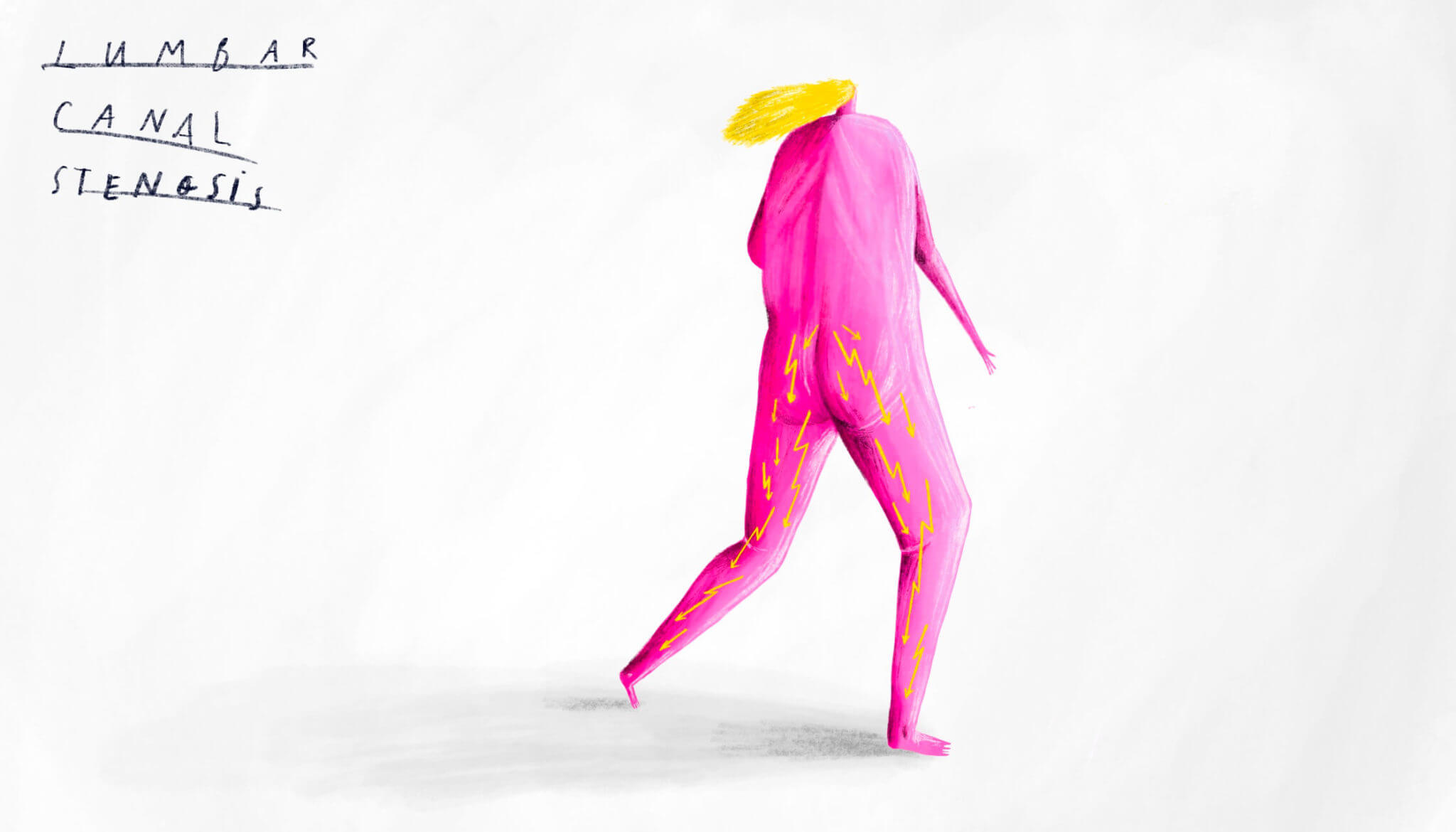
Lumbar canal stenosis (also known as spinal canal stenosis) is a condition where the spinal canal in the lower back narrows, causing arthritis which thickens bones, discs, and ligaments. This excess tissue eventually compresses the nerves running through the spinal canal in the lower back.
Lumbar canal stenosis compresses the nerves, leading to a condition called neurogenic claudication.
Nearly everyone experiences spinal wear and tear as they age. It’s a normal part of aging, much like getting wrinkles. In most people, this normal wear and tear does not cause any symptoms. A big part of my job is to work out if the wear and tear showing up on your scan is the cause of your symptoms.
Lumbar canal stenosis isn’t usually dangerous on its own. However, if left untreated, it can lead to complications such as cauda equina syndrome, which is a rare but serious condition that requires immediate medical attention to prevent permanent damage.
Symptoms often include pain or aching, tingling or weakness in the lower back, glutes and legs, especially when walking. Leaning on a shopping trolley or sitting down often helps relieve the pain and discomfort. This is because bending forward helps to open up space in the spine, easing compression and associated symptoms.
Many people with lumbar canal stenosis have no symptoms. It’s common to have narrowing without experiencing issues, and it’s usually safe.
There are two treatment options: surgical and non-surgical. The choice depends on your assessment of your quality of life.
If you can move around freely and are not in too much discomfort, injections, physiotherapy, or other therapies are viable options.
However, lumbar canal stenosis can be effectively treated with keyhole surgery, often providing a long-term solution with one procedure. If you’re struggling, modern keyhole surgery is a safe and effective option.
If you’re seeking a long-term solution, surgery is the only definitive option.
Imagine a rubber band tightly wrapped around your finger, causing pain and turning your finger blue. You could try exercises or injections, but simply removing the rubber band would fix the issue. Keyhole surgery works in much the same way, by removing the pressure on your nerves.
It isn’t dangerous but can affect your quality of life and reduce mobility. Once treated, most people return to near-normal function. It won’t cause permanent paralysis.
The most common cause is wear and tear, also known as arthritis. Arthritis is like a callus on your hand that thickens with friction over time.
It’s not genetic. Everybody gets some degree of arthritis as they get older. It’s just that some get it more than others for some reason. You may be lucky and have a great genetic bloodline whereby your spine responds to gravity and movement over the years very well without much wear and tear, but other than this there is no genetic reason why you did or did not get lumbar canal stenosis.
Stenosis of the spinal canal can occur at any level in the spine but it most commonly occurs in the lumbar spine. It occurs second most commonly in the cervical spine, causing a condition called cervical myelopathy. The thoracic spine is almost never involved.
Accurate diagnosis is crucial, as it can determine the success or failure of treatment. Just because you have lumbar canal stenosis doesn’t automatically mean it is the cause of your symptoms.
My job as a spine surgeon is to try to match any symptoms you may have with what I see on your scan and find on your examination. If there is a good match between all three then you have a very good chance of successful treatment. If there is not a good match, then this usually means there is something going on. It is literally detective work.
As you can see, this process is vital for avoiding unnecessary treatment including unnecessary surgery.
I have seen a lot of unnecessary spine surgery in Australia because this detective work was incomplete.
Recovery from surgery is around 12-18 hours before you can go home.
Steroid injections, medication, physio and chiro have essentially no risk. This is why patients are keen to try these first. Surgery is viewed as a last resort.
In my view, surgery is the first-line treatment because modern keyhole techniques are low-risk and highly effective. It deals with the root cause, eliminates the need for further injections and medication and allows physio to concentrate on building your balance and strength, rather than just trying to reduce your pain, which is a much better use of the physiotherapy resource.
In my view, keyhole surgery for lumbar canal stenosis is one of the best quality of life operations that can be performed by a spine surgeon. I will talk you through the minor risks of surgery (and how we manage them) at the consultation stage.
Lumbar canal stenosis is a gradually progressive condition, where wear and tear cause the bone and ligament to thicken over time. Symptoms tend to worsen gradually. You may have good days and bad days, even good and bad months, but overall, it will slowly progress.
That said, it isn’t dangerous. If you’re satisfied with steroid injections, medication, and physiotherapy, it’s safe to continue with this approach.