

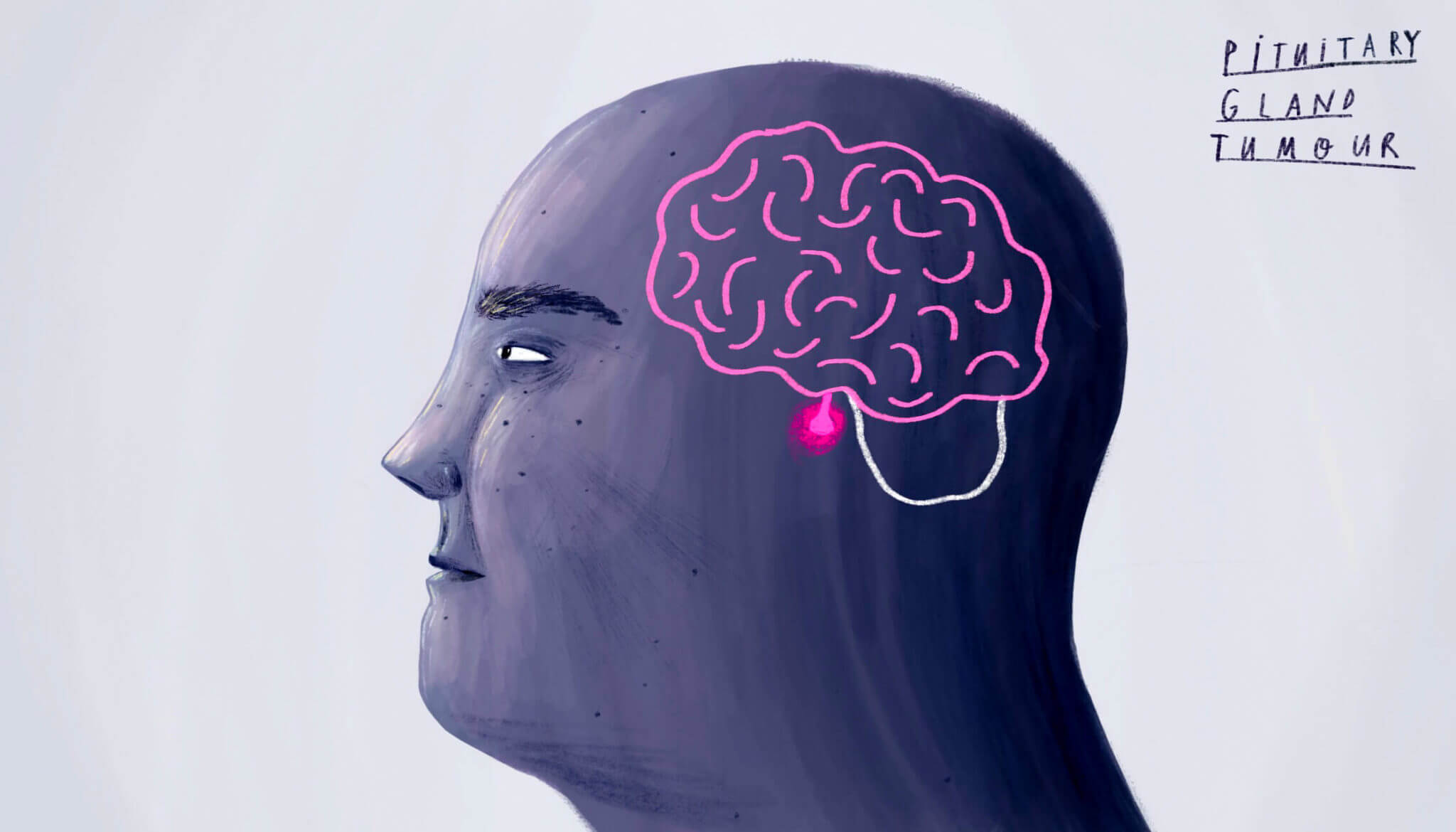
Pituitary tumours are tumours that form in the pituitary gland, a small organ located behind the eyes, near the base of the brain.
This gland plays a key role in producing essential hormones for the body’s normal functions, which are produced by specific groups of cells that are tightly packed together. It is from these groups of cells that the tumours can arise.
The hormones produced by the pituitary gland are:
The tumours also produce hormones, but as rogue cells, meaning they don’t respond to the normal control signals of the body.
Pituitary gland tumours are the fourth most common brain tumours that a neurosurgeon sees in their career.
The most common type of pituitary tumour is called a ‘non-functional pituitary adenoma.’ These tumour cells often produce mutated hormones that don’t work properly—like a wrong key that can’t unlock the body’s hormone receptors.
Less common are ‘functional’ tumours, which produce large amounts of normal hormones, overwhelming the body. It is this big excess of hormones that causes all the problems.
Non-functional type of tumours can threaten vision over time, and lead to severe health problems, even death.
On the other hand, functional tumours can result in very serious medical problems from the excess in hormone production. Urgent treatment is always required.
There are two methods in which a pituitary tumour will cause symptoms.
Symptoms arise when the tumour grows large enough to compress nearby structures in the brain, particularly the pituitary gland and the optic nerves. If the pituitary gland is compressed, it may stop producing essential hormones. Compression of the optic nerves can lead to vision loss, potentially causing blindness.
Symptoms occur when the tumour produces excess normal hormones, overstimulating their target areas in the body. Below are the effects of different hormones being overproduced by a tumour.
Polactin
Tumours from the prolactin cells, called prolactinomas, produce excess prolactin. This leads to infertility in both men and women and can cause galactorrhea (nipple discharge) in both sexes, which is a classic symptom.
Growth hormone
The tumours that arise from these cell groups in the pituitary gland produce an excess of growth hormones, causing body parts to grow disproportionately large, leading to a condition known as acromegaly. The most noticeable signs include a prominent square face, enlarged nose, and unusually large hands and feet.
ACTH
These tumours produce an excess of ACTH, leading to a condition called Cushing’s Disease, named after renowned neurosurgeon Harvey Cushing, who first described it. If left untreated, Cushing’s Disease is very dangerous, causing thin, fragile skin, fat accumulation in the cheeks, neck, and abdomen, skinny arms and legs, along with recurrent infections and diabetes.
TSH and LH/FSH
Tumours secreting these hormones are very rare. If the tumour affects TSH (thyroid-stimulating hormone), symptoms may include weight loss, a rapid heartbeat, irritability, and trouble sleeping. If it involves LH or FSH (luteinising and follicle-stimulating hormones), symptoms can include irregular periods, fertility issues, and changes in sex hormones—such as low libido or erectile dysfunction.
A combination of surgery, medication, and radiotherapy is often needed. After reviewing your scans and blood tests, I will determine the most effective treatment plan for your condition.
There are 3 main reasons for undergoing a pituitary gland tumour surgery.
Scans and blood tests can often reveal the type of tumour, but sometimes the diagnosis is unclear. In such cases, surgery may be needed to obtain a tissue sample for testing to confirm the tumour type.
If the tumour is pressing on the vision nerves or compressing the pituitary gland, surgery is needed to relieve the pressure, potentially saving your vision and the gland. This is one of the most common reasons for surgery.
The goal is to achieve a cure by removing the entire tumour. This makes it crucial for a pituitary specialist to perform the surgery, as they are more likely to successfully achieve complete removal compared to a non-specialist.
The surgery is minimally invasive and performed using a keyhole technique through the nose with a small telescope. You won’t look any different after the procedure, as it’s all done internally, with no change to the shape or size of your nose.
There are always risks with this kind of procedure (e.g. not all the tumour can be removed, the tumour may reoccur, infection, bleeding, leaking of brain fluid through the nose). Fortunately, with modern technology and equipment, the risks are significantly less than what they used to be 20 or even 10 years ago.
When I assess you, I’ll determine whether surgery is the best option for you and how much of the tumour can be safely removed, along with what this means for your overall outlook.
Receiving a brain tumour diagnosis is devastating. It’s crucial that you feel as in control as possible. That includes knowing everything you can before going into treatment. And I’m here to guide you through that process.
Neurosurgery has come a long way in modern times.
Now surgery can be done quite routinely and with relatively quick recovery.
Remember, our main goal is to improve your quality of life. We do this by removing as much of the tumour as possible. Performing an operation that leaves you the same, or even worse, doesn’t help us achieve that goal. My modern approach avoids aggressive surgery that tries to remove everything at the expense of your well-being. When I see you, I’ll explain everything in detail, including how we can get you through this as effectively and safely as possible.
It is the fourth most common brain tumour that a neurosurgeon sees in their career.
There is nothing that you did to cause it and nothing you could have done to prevent it. It’s just pure bad luck.
Pituitary tumours are dangerous. Non-functional tumours can threaten vision over time, and lead to severe health problems, even death. Risk of heart attack is very high in people with Cushing’s disease and acromegaly.
Luckily it’s not herditary. You don’t inherit it from your parents and you won’t pass it down to your children.
Yes, and that is why these tumours need prompt treatment by a specialist. If you would like me to see your case then contact my team as soon as you can.
Sometimes these tumours are monitored rather than treated immediately. However, this decision must be made by a specialist who can assess whether the tumour poses a risk to your health. If you’d like a specialist review of your case, please contact my team.
Unfortunately, there is nothing you can do to prevent it. The likelihood of recurrence depends on various factors, such as the success of your surgery, the type of tumour, and whether you need further treatment like medication or radiotherapy. If you’d like a thorough assessment, please contact my team.
The cure rate is reasonably good in specialist hands.
News of a brain tumour for you or your loved ones is devastating. It comes like a freight train. Out of nowhere. And brings a million questions with it. That’s where I come in. My team and I are more than happy to review your case.