

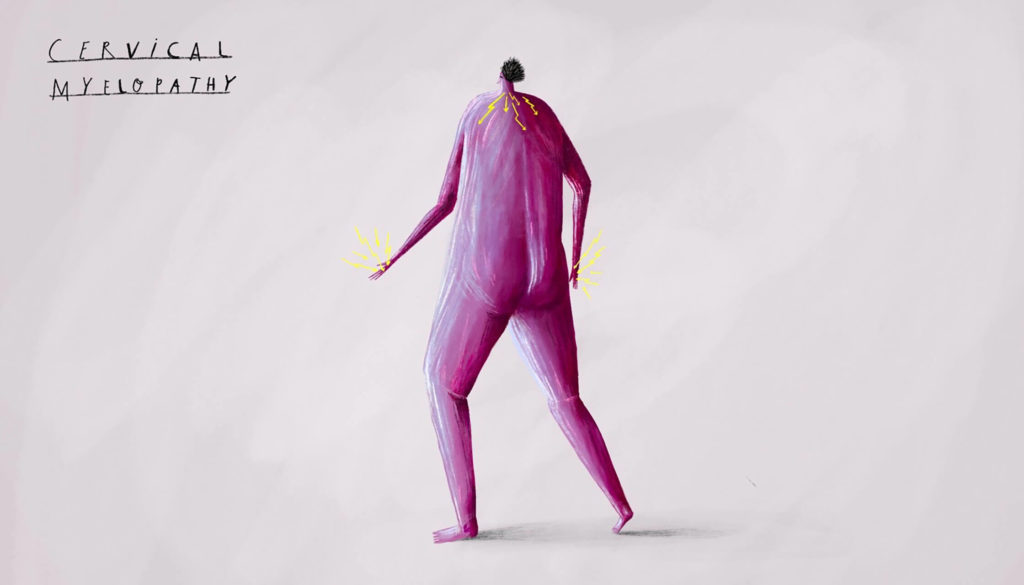
Cervical myelopathy refers to the symptoms that arise when the spinal cord is gradually compressed by arthritis in the cervical spine.
Arthritis is similar to a callus on your hand; with force and friction, tissues thicken over time.
Likewise, with the force of gravity and spinal movement over years, the bones, disc, and ligament tissues tend to thicken up. It is this excess tissue that encroaches on and eventually compresses the spinal cord.
This compression blocks many electrical signals that normally travel through the spinal cord, much like a traffic jam on a busy highway.
Early symptoms include numbness, clumsiness in the hands, and unsteadiness in the legs, and as the condition progresses, the muscles in the arms and legs become increasingly stiff and rigid. This is very serious because there’s a high risk your symptoms will become permanent.
While the condition is serious, the origins of the word myelopathy are quite interesting. Anything to do with the spinal cord is termed ‘myelo’. But myelo also means bone marrow (like myeloma-cancer of the bone marrow). The reason the early anatomists also called the spinal cord ‘myelo’ is because it actually looks very much like bone marrow. Not the red marrow you see in the ends of bones, but the white fatty marrow you see in the middle of long bones. Having seen inside a long bone being chewed by my pet Dachshund, and having also seen inside the spinal cord, I can confirm they look nearly identical!
Anything to do with the spinal cord is termed ‘myelo’, and ‘pathy’ means pathology, or problem. So myelopathy means pathology or problem of the spinal cord.
Cervical myelopathy it’s not common. For example, radiculopathy (sciatica, femoratica, brachialgia) is far more common.
However, when cervical myelopathy occurs, it must be recognised and treated early.
Without surgery, this condition will continue to worsen, leading to serious deterioration and possible permanent spinal cord damage.
Surgery is strongly recommended—at the earliest possible convenience—and should be performed by an experienced neurosurgeon.
Early on, that patient notices numbness and clumsiness in their hands and a feeling of unsteadiness in their legs. As it progresses, these sensations worsen, to the point where the patient notices their hands are not only numb and uncoordinated but really stiff, also affecting their walking, which makes the unsteadiness in their legs even worse. This is a sign of a severe traffic jam in the spinal cord due to the compression.
Surgeons can quickly recognise cervical myelopathy by a patient’s walk, known as a scissor gait. The legs become so stiff that they can no longer bend the knees or hips properly, resembling scissor blades opening and closing.
By far the most common cause of cervical myelopathy is wear and tear, also called arthritic changes.
Arthritis can be compared to a callus on your hand, which with force and friction on your hand, tends to thicken up. Likewise, with the force of gravity and spinal movement over years, the bones, disc and ligament tissues tend to thicken up. It is this excess tissue that encroaches on and eventually compresses the spinal cord.
The only treatment for cervical myelopathy is surgery. The spinal cord is physically compressed, and the only way to relieve this is to surgically remove the compression. Medications, injections, or physiotherapy will not work.
The two most common operations to treat cervical myelopathy are:
One of the most common spinal operations performed in Australia. ACDF takes away the front of the spinal canal to create more space for the spinal cord.
A procedure that takes away the back of the spinal canal to create more space for the injured spinal cord.
Yes, it is dangerous. Treatment is usually required within 1-2 weeks of diagnosis, or sooner if possible.
There is a significant chance your neurological symptoms, such as clumsy hands or unsteady feet, are already permanent. Delaying treatment increases the risk of unnecessary loss of function.
No, cervical myelopathy is not genetic. Everyone develops some degree of arthritis as they age, but some are affected more than others.
Yes, surgery is necessary. If the diagnosis has been confirmed by your surgeon through scans, questions, and examination, surgery should be performed as soon as possible. Please contact my team ASAP if you think you or a family member has this serious condition.
The primary aim of surgery is to stop things from getting worse. It relieves pressure on the spinal cord but cannot repair existing damage. If the spinal cord recovers, it will do so naturally over time, though unfortunately, this doesn’t always happen.
Surgery aims to prevent further damage to the spinal cord by taking the pressure off the spinal cord. Surgery cannot repair the damage to the spinal cord. Occasionally, some patients notice an improvement after surgery, but this is the exception rather than the rule.
No, there are no non-surgical treatments. Physiotherapy, chiropractic care, or other methods will not help and may worsen the condition, potentially leading to paralysis.
Surgery is the only effective treatment. Anything else will only cause further damage to your spinal cord and further increase your chances of ending up in a wheelchair. Other than cancer, infection or fractures, this is the single most serious condition in the spine.
It usually takes about two weeks to start feeling more normal after surgery. During this time, I’ll encourage you to remain active. You’ll likely regain your confidence around the two-week mark.
The surgery carries about a 5% risk of complications. However, without surgery, there is a 100% chance of worsening symptoms, which may result in paralysis or the need for a wheelchair.
Anyone who recommended this strategy for cervical myelopathy would be considered negligent by all experts around the world.
I will assess you and all your scans to give recommendations on what might be useful in the future to reduce the chances of something similar ever happening again.
The goal of surgery is to prevent further decline, not necessarily to improve your symptoms. It can be helpful to think of any improvement post-surgery as a bonus, and focus on how the intervention has stopped things getting worse. Recovery depends on the severity and duration of spinal cord compression and the expertise of your surgeon in removing all the compressing tissue.